Acclaimed American poet, educator, activist, and autobiographer, Maya Angelou, once said that in order to be an effective mentor, one must care. She went on to say that an effective mentor should care about what they know, and care about the person they are sharing it with.
A mentor is many different things on different days but is always endlessly interested in the quality of the learning experience and the well-being of their mentee. In short, they care.
It has been a long-standing tradition of the NIH Oxford-Cambridge Scholars Program to pause each year to recognize an outstanding mentor among the many faculty members who serve the Program across the NIH, and at the Universities of Oxford and Cambridge. Nominations for this honor come from those who are the fortunate recipients of outstanding mentoring – the mentees.
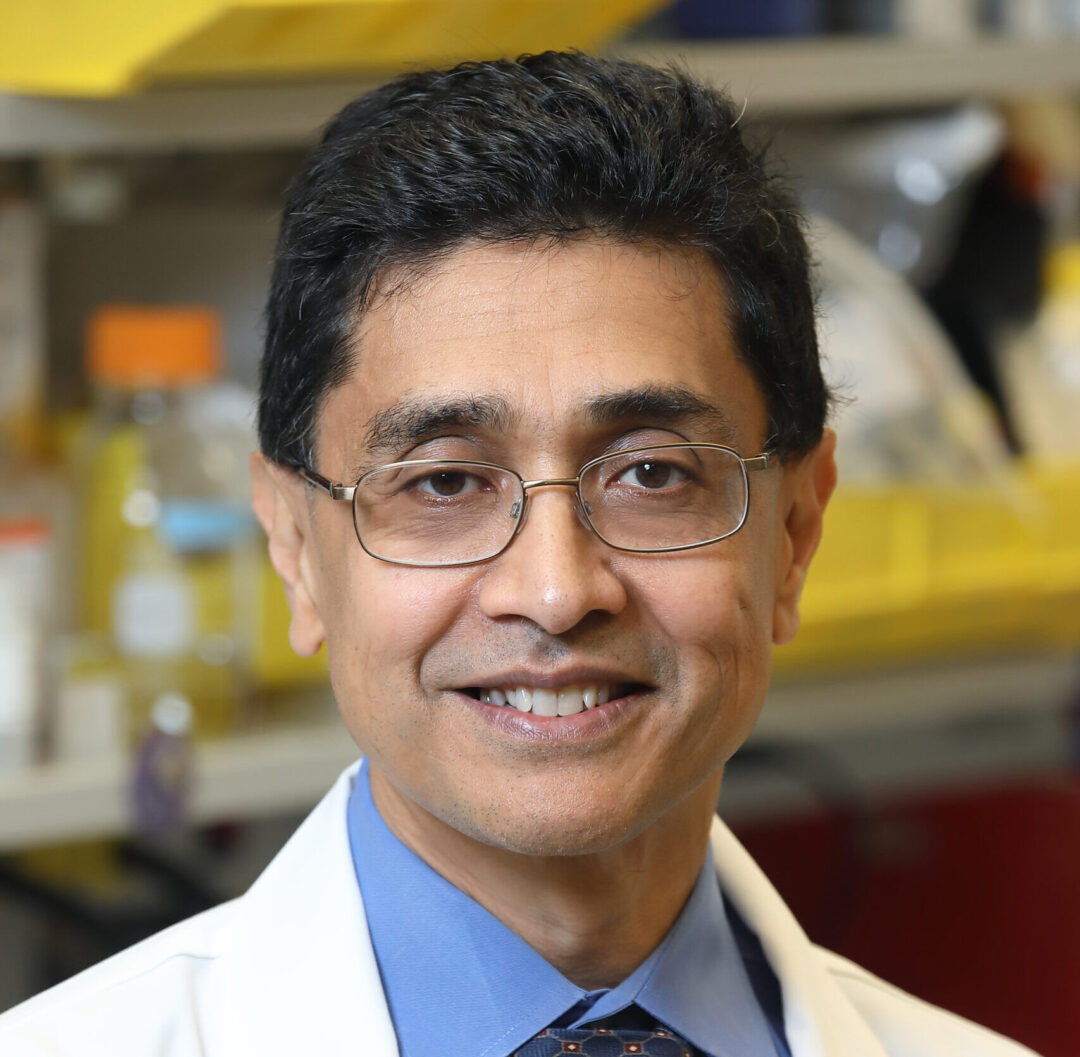
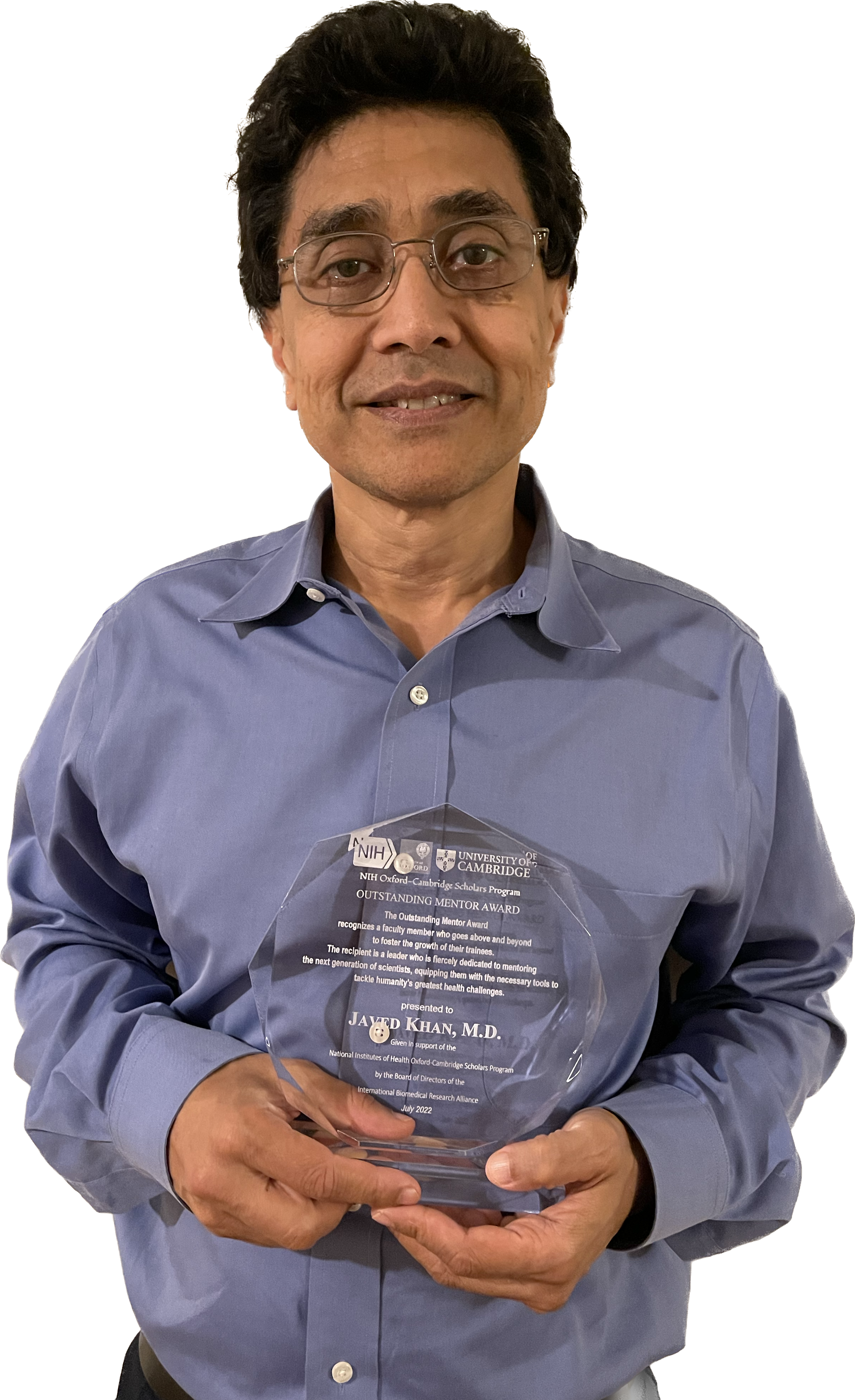
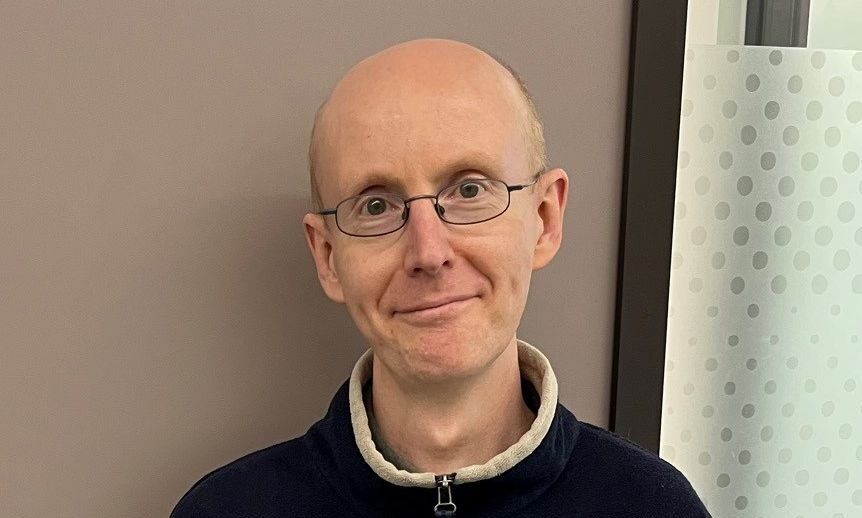
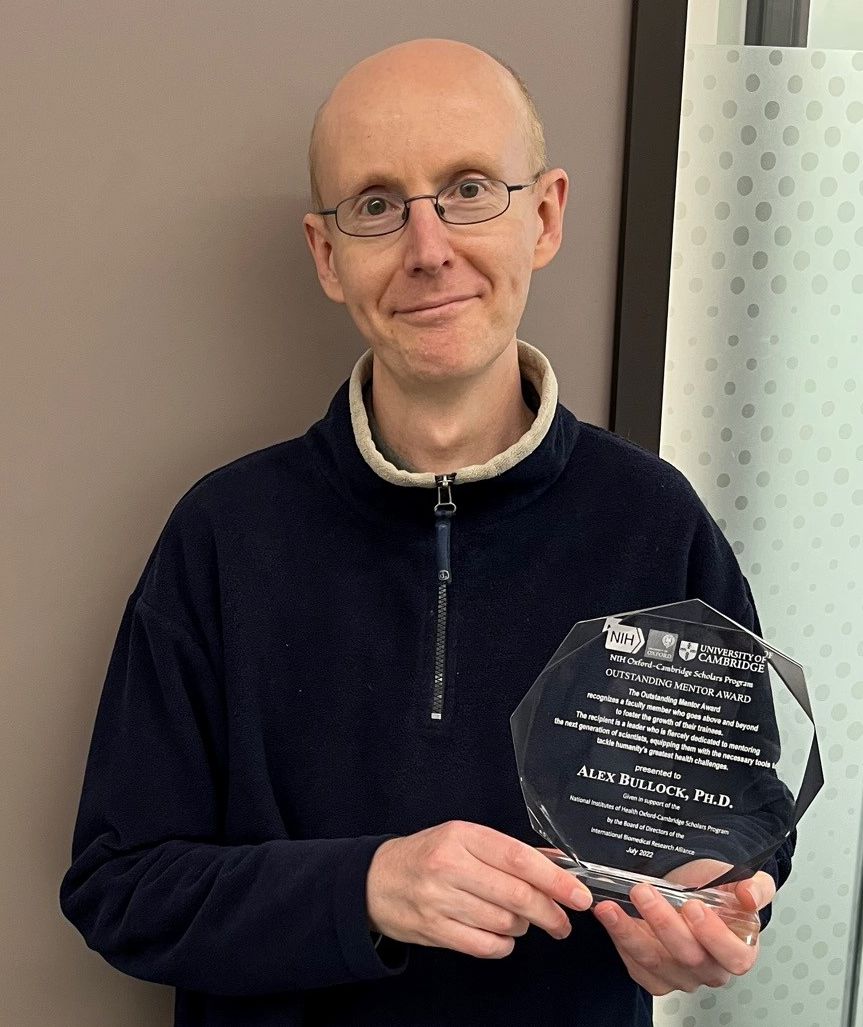
This year, this award recognized two Outstanding Mentors, Dr. Javed Khan and Professor Alex Bullock. They are leaders who are fiercely dedicated to mentoring the next generation of scientists, equipping them with the necessary tools to tackle humanity’s greatest health challenges.
Dr. Javed Khan was nominated by his mentee, Katherine Masih. In submitting this nomination, she wrote: “I’ve been a student in Javed’s lab since my research year in the NIH Medical Research Scholars Program. While I’ve been fortunate to have worked with several outstanding scientific mentors, I can without a doubt say he is the best mentor I’ve ever had. Javed is a true role model for a physician-scientist, promoting the values of compassion, integrity, and drive both in the laboratory and the clinic. He values each team member’s contributions to a project or accomplishment and facilitates a truly collaborative lab atmosphere where we go out of our way to help each other to improve everyone’s science. He makes a point of getting to know what each trainee’s goals are and provides us with speaking and writing opportunities, and never shies away from elevating us for awards or recognition for our work. While he’s never at a loss for great ideas or encouragement, Javed has always given me the freedom to make my own scientific decisions for my projects, while still pushing me to think critically about what and why I’m doing experiments. His steadfast support has given me the confidence to spearhead projects and gain independence as a scientist. Without his encouragement and valuing my scientific training over expedience, I would not be where I am today, and I consider him a lifelong mentor at the bench, in the clinic, and in life.” Thank you, Dr. Khan, for going above and beyond for your trainees.”
Exceptional mentorship continues to be a cornerstone feature of the NIH Oxford-Cambridge Scholars Program since its inception in 2001.
Acclaimed American poet, educator, activist, and autobiographer, Maya Angelou, once said that in order to be an effective mentor, one must care. She went on to say that an effective mentor should care about what they know, and care about the person they are sharing it with.
A mentor is many different things on different days but is always endlessly interested in the quality of the learning experience and the well-being of their mentee. In short, they care.
It has been a long-standing tradition of the NIH Oxford-Cambridge Scholars Program to pause each year to recognize an outstanding mentor among the many faculty members who serve the Program across the NIH, and at the Universities of Oxford and Cambridge. Nominations for this honor come from those who are the fortunate recipients of outstanding mentoring – the mentees.
This year, this award recognized two Outstanding Mentors, Dr. Javed Khan and Professor Alex Bullock. They are leaders who are fiercely dedicated to mentoring the next generation of scientists, equipping them with the necessary tools to tackle humanity’s greatest health challenges.
David Cruz Walma nominated Professor Alex Bullock, of the University of Oxford, “as an outstanding mentor, leader, and scientist…. Prof. Bullock is known amongst all who work with him…. as a truly exceptional mentor. When I was first applying to the NIH Oxford-Cambridge Scholars program in 2019, I contacted Professor Rob Gilbert and asked for his guidance in selecting an Oxford mentor. Professor Gilbert immediately replied that Prof. Bullock was one of the best supervisors/mentors in the department, and likely the entire University.”
David went on to say that “Prof. Bullock’s abilities as a mentor were evident from the start of my D.Phil. and were paramount in helping me push through early setbacks. Since that seemingly insurmountable setback in my D.Phil. career, I have solved the protein structure of a novel protein mutation implicated in a genetic syndrome (being published now), have published three other papers, and am on track to complete my DPhil studies on time (even with the pandemic and a physical lab building move that took away 4+ months of experiments), all due to Prof. Bullock’s guidance and positive attitude. I am not the only student who recognizes Prof. Bullock’s abilities as he oversees the most D.Phil. students of any supervisor in our department. On behalf of all of Prof. Bullock’s students, past and present, I nominated him for the 2022 Outstanding Mentor Award.”
Exceptional mentorship continues to be a cornerstone feature of the NIH Oxford-Cambridge Scholars Program since its inception in 2001.
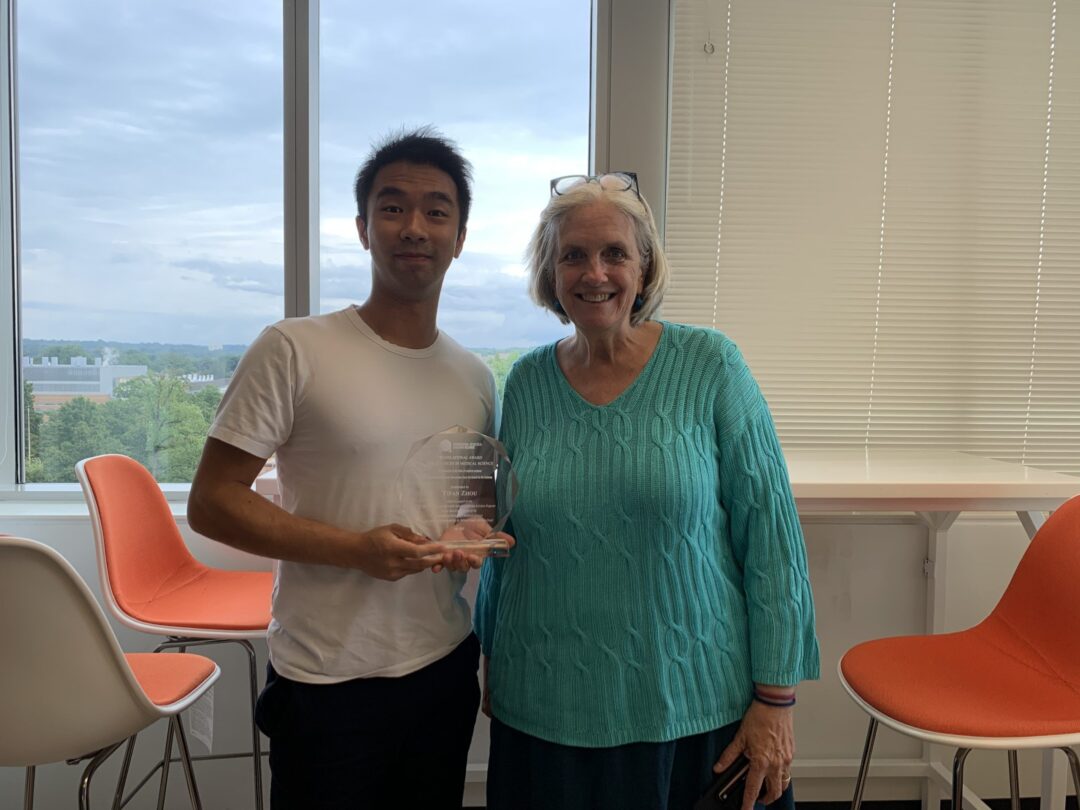
First awarded in 2016, the Dr. Richard and Vera Siegel Translational Award was generously endowed by NIH M.D./Ph.D. Partnership Program co-founder, Dr. Richard Siegel, and his wife, Vera. This annual award recognizes advances in the field of medical science that move fundamental discoveries from the bench to the bedside. The recipient of the Translational Award this year was the Class of 2018 NIH-Cambridge Ph.D. Scholar Yifan Zhou who is jointly mentored by Dr. Cindy Dunbar at the National Heart, Lung, and Blood Institute (NHLBI/NIH) and Professor George Vassiliou at the University of Cambridge.
Yifan’s nominator detailed that he masterfully completed his planned project as well as pivoted to new projects when his plans were disrupted by the pandemic. Despite the many challenges that were thrown at him, Yifan completed one of his two initially planned primary projects, demonstrating that macaques are a robust model for human age-related clonal hematopoiesis, now accepted and in press at the premier hematology journal Blood, with Yifan as a co-first author. Since there could be a potential link between age-related hematopoiesis (ARCH) and COVID-19 disease severity, Yifan took on a second project and worked with multiple NIH, UK, and Italian collaborators to collect over 500 sets of samples and clinical annotations to test this hypothesis. He performed the sequencing and analyses and worked with statisticians to come to very firm conclusions, that there is no relationship of COVID-severity to ARCH and this work is under revision also with Yifan as the sole first author.
Finally, Yifan designed and began an additional project at the NIH utilizing his experience to create a disease model for RUNX1 deficiency in macaques to ask whether gene therapies for this disorder would likely be feasible and prevent progression to acute myeloid leukemia. This work generated the first model for human RUNX1 deficiency providing important evidence that gene correction therapies would be unlikely to reverse the premalignant phenotype and is currently being submitted to a high-profile translational journal.
Yifan’s work did not stop at the bench. He taught himself to program and perform sophisticated genomic analyses and has mentored two students in his lab who can attest to his generosity, hard work, cheerful outlook, and vast knowledge. By the time Yifan graduates, he will have at least five first-author publications and we are looking forward to his future work and accomplishments.
“I am very humbled to have been awarded the Dr. Richard and Vera Siegel Translational Award at the 2022 NIH Global Doctoral Partnerships Annual Workshop Awards Ceremony, for my research on the implication of clonal hematopoiesis. I wish to dedicate this award to my mentors, Cindy and George, for their unconditional support and faith throughout my PhD both in and outside the lab, and I have been surrounded by the most talented colleagues who have taught me all the skills. I still recall when I interviewed with Cindy and told her that I had zero background in bioinformatics and hematology but would still love to embark on projects driven by large datasets and hopefully make a direct impact in the patient care setting. I was expecting to be turned down, but instead, she just asked me ‘would you be willing to learn, and I said of course. Since then, it has been a wonderful journey with something new to learn each and every day. I am also very grateful for the support from the International Biomedical Research Alliance the OxCam Program that allowed us to continue our research during the pandemic. I also want to give a special thanks to Dr. Richard and Vera Siegel’s generous support for this Award.”
Yifan will be completing his PhD by early 2023, and following this, he plans to move to Boston and extends his research interest and skills into independent postdoctoral positions.
“Vera and I are delighted that Yifan Zhou has been given this award. His studies of age-related clonal hematopoiesis is a great example of translating findings between human and animal models, and his work on RUNX1 lays important foundations for gene therapy in humans. Hearing first-hand from Yifan about pivoting his PhD work towards analyzing the impact of ARCH on COVID-19 outcomes shows how he and so many other young researchers have been able to take advantage of the unique circumstances of the pandemic, learn new techniques, and make unexpected and important discoveries. I wish all the best for Yifan for what I’m sure will be a great career in translational research,” remarked Dr. Richard Siegel.
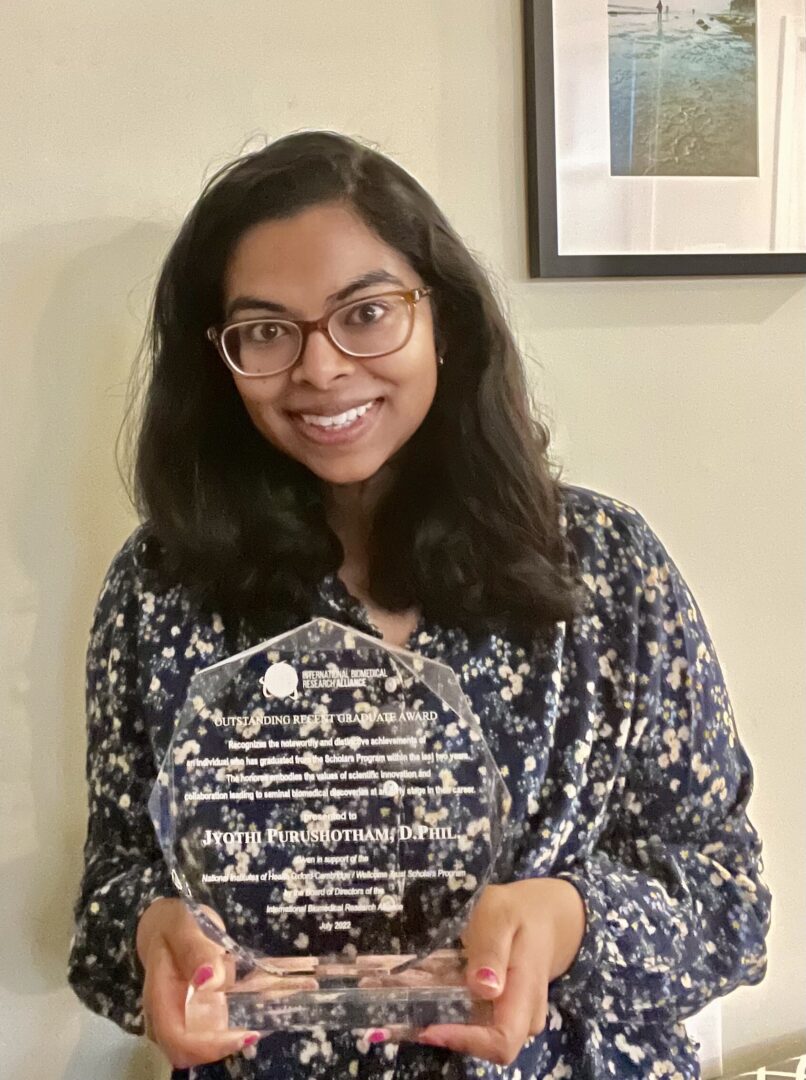
The International Biomedical Research Alliance’s Outstanding Recent Graduate Award was created to recognizethe noteworthy and distinctive achievements of an individual who has graduated from the NIH Oxford-Cambridge Scholars Program within the last two years. The honoree embodies the values of scientific innovation and collaboration leading to seminal biomedical discoveries at an early stage in their career. The 2022 Outstanding Recent Graduate Award was bestowed upon Dr. Jyothi Purushotham.
Jyothi Purushotham was an NIH-Oxford D.Phil. Scholar in the Class of 2017, with mentors Dr. Vincent Munster at the National Institute of Allergy and Infectious Diseases (NIAID) working in the NIH’s Rocky Mountain Laboratories in Hamilton, Montana, and Professor Dame Sarah Gilbert at the University of Oxford. Jyothi began her D.Phil. working on the development of a vaccine against Lassa fever virus with Prof. Sarah Gilbert’s group in Oxford and Vincent Munster’s group at NIH. When the Covid-19 pandemic began, Jyothi quickly switched to assist with the development of animal models for SARS-CoV-2 vaccine efficacy testing and played a crucial role in providing data that allowed clinical trials of the Oxford AstraZeneca vaccine to be initiated. Jyothi’s thesis was a mixture of the Lassa and Covid vaccine development work, and one of the examiners at her viva said that she wished they could “award two DPhil degrees, one for each part of the work, as each was worthy of a degree.”
Dr. Purushotham is currently a postdoctoral researcher in the Andersen Lab at The Scripps Research Institute in La Jolla, California. Her research focus remains within the discipline of infectious disease immunology; however, rather than developing vaccines she now studies immune responses to natural infection by viral pathogens. Specifically, her work aims to apply ‘systems biology’ tools to elucidate features of immune dysregulation underlying post-acute infection syndromes, such as after COVID-19 and Lassa fever.
Commencing in 2020, The International Biomedical Research Alliance introduced a service recognition award to honor Scholars in the NIH Oxford-Cambridge/Wellcome Trust Scholars Program who demonstrate exceptional community service. Awardees are nominated by their peers to be recognized for their exceptional service, not only to the Scholars Program but also to the greater NIH and University communities. It is an honor to be recognized, but especially notable when the recognition comes from peers who have a unique and focused view of the awardees and their efforts. The ceremony to honor the winner was held during the NIH Global Doctoral Partnerships Research Workshop held at Keble College, the University of Oxford July 26-28, 2022.
The Building a Better Community Through Service Award recognizes a Scholar for their outstanding service to the community. The Award honors an individual who continuously places significant importance on the well-being of their community. Committed to social responsibility, they invest their time and talent to elevate and inspire others and, in doing so, uplift the community as a whole.
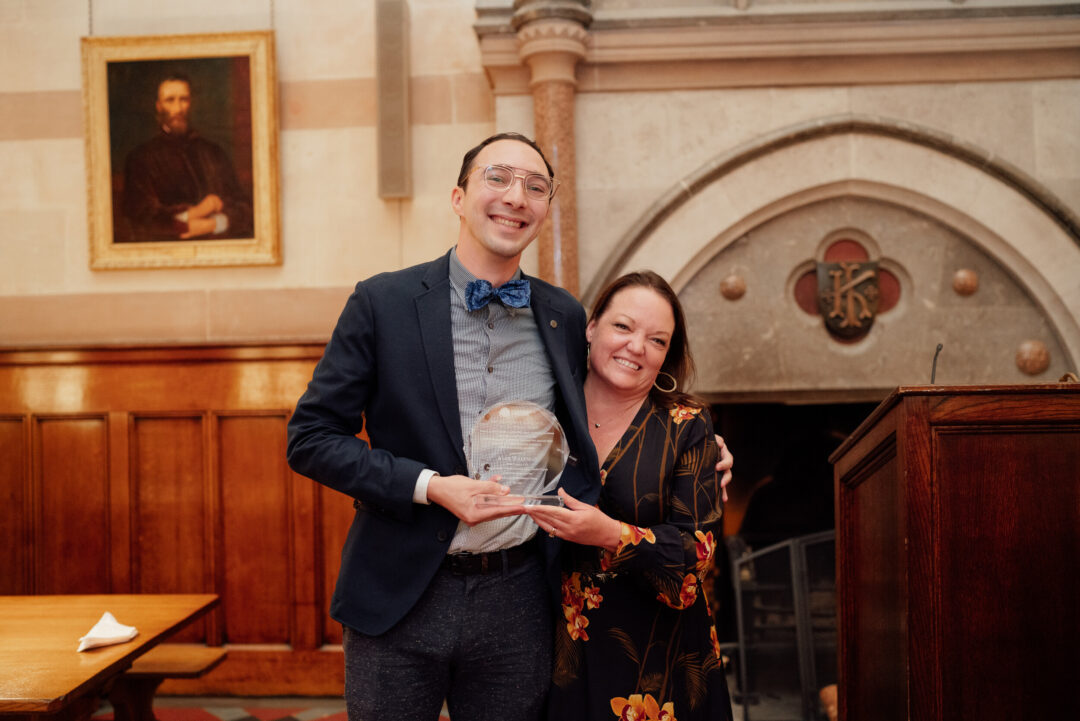
The “Building a Better Community Through Service Award” was bestowed upon Alex Waldman. Alex Waldman is an NIH-Oxford MD/DPhil Scholar in the Class of 2018. His mentors are Dr. Michael Lenardo at the National Institute of Allergy and Infectious Diseases and Professor Gabriele DeLuca at the University of Oxford. He is a medical student at Emory University. Since joining the NIH OxCam Program in 2018, Alex has been dedicated to serving this community. Through numerous positions on the Student Leadership Board, leading the American Physician Scientists Association, and now through leading the Annual Workshop Committee, Alex has consistently demonstrated his values of a strong community and creating spaces for his peers to connect and grow both personally and scientifically. His nominator shared, “his warm, welcoming, and gregarious manner enables him to be inclusive to all members of the community.” Without a doubt, his contributions have directly impacted the strength of the OxCam community and made him eminently deserving of this honor.
Reflecting on winning this award Alex said “The COVID-19 pandemic and the uncertainties it continues to bring have really reinforced to us the importance of fostering a strong community. Therefore, it was particularly heartwarming to receive this honor at our first in-person Workshop in 3 years. As my time in the Program marches toward its conclusion, I have had the pleasure of working closely with the student body, Program leadership, and many members of the International Biomedical Research Alliance which is something that I consider a major highlight of my Ph.D. experience. Once again, thank you to the Directors of the International Biomedical Research Alliance for being such staunch supporters of the Program and the student body. We couldn’t pursue our dream to improve human health through biomedical research and clinical practice without you in our corners each step of the way. I look forward to the next stage of my training and very much hope we get to work together further moving forward.”